

Hey there! As a supplier of Aluminum Profile CNC Machine Tools, I often get asked about how these nifty machines work. So, I thought I'd take a few minutes to break it down for you in plain English.
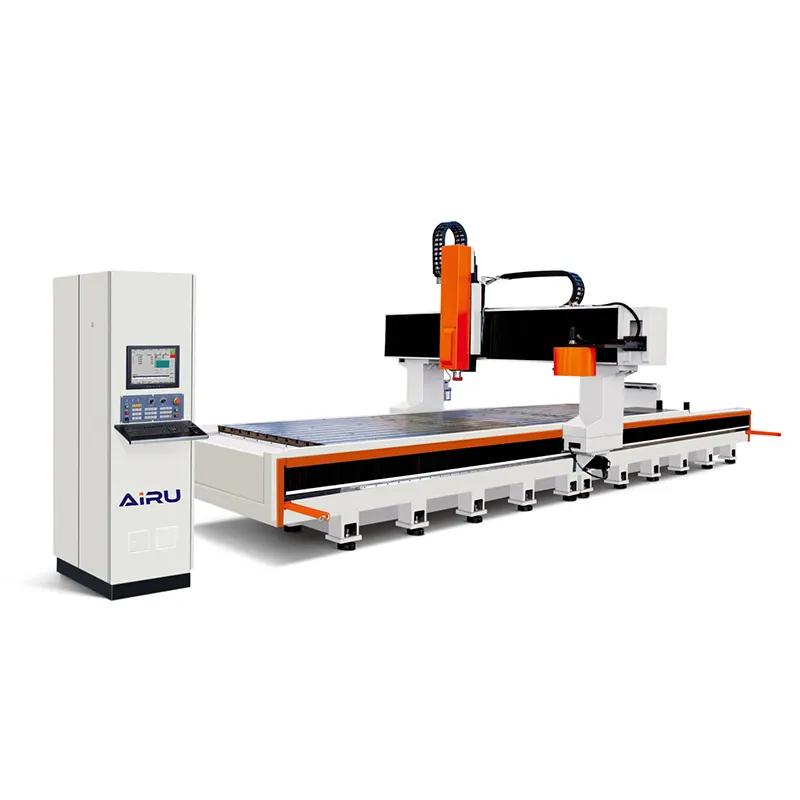
Let's start with the basics. An Aluminum Profile CNC Machine Tool is a computer-controlled device that's designed to cut, shape, drill, and mill aluminum profiles with high precision. These machines are used in a wide range of industries, from construction and automotive to aerospace and electronics. They're incredibly versatile and can handle all sorts of aluminum profiles, whether they're used for making window frames, curtain walls, or industrial components.
The Core of the Machine: The CNC System
At the heart of every Aluminum Profile CNC Machine Tool is the Computer Numerical Control (CNC) system. This is what makes these machines so special. The CNC system is like the brain of the machine. It takes instructions from a computer program and uses them to control the movement of the cutting tools and the workpiece.
Think of it this way: You create a design on your computer using a CAD (Computer-Aided Design) software. Then, you convert that design into a CNC program using a CAM (Computer-Aided Manufacturing) software. This program contains a series of commands that tell the machine where to move, how fast to move, and what kind of cutting action to perform.
Once the program is loaded into the CNC system, the machine is ready to go. The system reads the commands one by one and translates them into electrical signals. These signals are then sent to the machine's motors, which control the movement of the cutting tools along the X, Y, and Z axes.
Axes of Movement
The X, Y, and Z axes are the three main directions in which the cutting tools can move. The X-axis usually represents the horizontal movement from left to right, the Y-axis represents the horizontal movement from front to back, and the Z-axis represents the vertical movement up and down.
Some advanced Aluminum Profile CNC Machine Tools, like the 3-Axis CNC Profile Machining Center, can move the cutting tools along all three axes simultaneously. This allows for more complex and precise machining operations.
For example, if you want to drill a hole in an aluminum profile, the machine will first move the cutting tool to the correct position along the X and Y axes. Then, it will lower the tool along the Z axis to perform the drilling operation. Once the hole is drilled, the machine can move the tool to the next position and repeat the process.
Cutting Tools
Another important part of an Aluminum Profile CNC Machine Tool is the cutting tools. These tools come in a variety of shapes and sizes, depending on the type of machining operation you want to perform. Some common cutting tools used in these machines include drills, end mills, and routers.

Drills are used for making holes in the aluminum profile. They come in different diameters and can be used to create holes of various sizes. End mills, on the other hand, are used for milling operations. They can be used to cut flat surfaces, grooves, and slots in the aluminum profile. Routers are similar to end mills but are often used for more intricate cutting operations, such as cutting curves and contours.
The machine's CNC system controls the speed and feed rate of the cutting tools. The speed refers to how fast the tool rotates, while the feed rate refers to how fast the tool moves along the workpiece. These parameters are crucial for achieving a high-quality finish and preventing damage to the cutting tools and the workpiece.
Workholding Devices
To ensure accurate and stable machining, the aluminum profile needs to be held securely in place during the machining process. This is where workholding devices come in. There are several types of workholding devices used in Aluminum Profile CNC Machine Tools, including vises, clamps, and fixtures.
Vises are the most common type of workholding device. They consist of two jaws that can be tightened around the aluminum profile to hold it in place. Clamps are another option. They can be used to secure the profile to the machine's worktable. Fixtures are more complex workholding devices that are designed to hold the profile in a specific position and orientation. They are often used for mass production or for machining complex parts.
Applications of Aluminum Profile CNC Machine Tools
Aluminum Profile CNC Machine Tools are used in a wide range of applications. One of the most common applications is in the construction industry. These machines are used to manufacture aluminum window frames, doors, and curtain walls. The Aluminum Curtain Wall Processing Equipment is specifically designed for this purpose. It can cut, drill, and mill aluminum profiles with high precision, ensuring a perfect fit and a high-quality finish.
In the automotive industry, Aluminum Profile CNC Machine Tools are used to manufacture components such as engine parts, suspension parts, and body panels. The high precision and repeatability of these machines make them ideal for producing parts that require tight tolerances.
The aerospace industry also relies heavily on Aluminum Profile CNC Machine Tools. These machines are used to manufacture aircraft components such as wing spars, fuselage frames, and engine mounts. The lightweight and high-strength properties of aluminum make it an ideal material for aerospace applications, and the CNC machines ensure that the components are manufactured to the highest standards.
Another important application is in the electronics industry. Aluminum Profile CNC Machine Tools are used to manufacture enclosures, heat sinks, and other components for electronic devices. The ability to create complex shapes and precise holes makes these machines essential for producing high-quality electronic components.
Advantages of Using Aluminum Profile CNC Machine Tools
There are several advantages to using Aluminum Profile CNC Machine Tools. First and foremost, they offer high precision and accuracy. The CNC system ensures that the cutting tools move exactly where they need to go, resulting in parts that are consistent and meet the required specifications.
Secondly, these machines offer high productivity. Once the program is loaded into the CNC system, the machine can run continuously without the need for constant operator intervention. This allows for faster production times and increased efficiency.
Another advantage is the flexibility. The same machine can be used to manufacture different types of aluminum profiles simply by changing the CNC program. This makes it easy to adapt to changing production requirements.
Finally, Aluminum Profile CNC Machine Tools offer a high level of safety. The CNC system controls all aspects of the machining process, reducing the risk of operator error and accidents.
Conclusion
So, there you have it! That's a basic overview of how an Aluminum Profile CNC Machine Tool works. These machines are truly amazing pieces of technology that have revolutionized the way we manufacture aluminum profiles.
If you're in the market for an Aluminum Profile CNC Machine Tool, whether it's for the construction, automotive, aerospace, or electronics industry, we've got you covered. Our Industrial Aluminum Profile Processing Equipment is designed to meet the highest standards of quality and performance.
If you have any questions or would like to discuss your specific requirements, don't hesitate to reach out. We're here to help you find the perfect machine for your needs and to support you throughout the entire process. Let's start a conversation and see how we can work together to take your production to the next level.
References
- "CNC Machining Handbook" by Peter Smid
- "Manufacturing Engineering and Technology" by Serope Kalpakjian and Steven Schmid