

If you’ve ever walked through a factory where aluminum doors, windows, or curtain walls are being fabricated, you’ve likely spotted a single head copy milling machine at work. These tools are workhorses for precision machining: they cut mortises, grooves, and duplicate profiles into aluminum extrusions with speed and consistency, making them indispensable for aluminum fabrication lines. But as a supplier of these machines, I can tell you that performance isn’t the only thing that matters—safety is non-negotiable. A single head copy milling machine has several critical safety interlocks built into its design to protect operators, prevent equipment damage, and keep production running smoothly. Today, I’m breaking down exactly what those interlocks are, why they matter, and how they keep our machines and teams safe.
First, let’s ground this in what a single head copy milling machine does, just to set context. Unlike other milling tools that may have multiple heads or complex automation, the single head model is designed for focused, one-at-a-time machining: it clamps an aluminum extrusion, uses a rotating cutter to match a template or a digital design, and removes material with tight tolerances. It’s simpler than multi-head units, but that doesn’t mean it skips on safety. Many operators I work with at this company tell me they’ve seen (or heard of) accidents when interlocks fail—things like loose workpieces flying, or hands accidentally entering the cutting zone. That’s why every interlock on these machines serves a specific purpose, tailored to the risks of milling aluminum, which has sharp, fast-spinning cutters and heavy workpieces that can shift unexpectedly.
One of the most fundamental interlocks on any single head copy milling machine is the workholding clamp interlock. Here’s how that works: the machine won’t activate the milling cutter unless the workpiece is securely clamped in place. At first glance, that seems obvious—if the aluminum isn’t held tight, the cutter will catch the material, yank it loose, and send it flying at hundreds of feet per second, which is a huge hazard. But not all clamp interlocks are created equal. The machines I supply don’t just rely on a pressure sensor to tell if a clamp is on; we use a dual-sensor system: one that detects physical contact between the clamp and the extrusion, and another that verifies the clamping force meets a pre-set threshold (usually around 1,500 to 2,000 pounds of force, depending on the extrusion size). That way, even if a clamp is visually touching the aluminum but isn’t tightened enough, the machine stays off. This interlock is so reliable that it’s the first line of defense for preventing workpiece-related accidents. If you’re shopping for a milling machine, always check that it has this dual sensor system—not just a basic limit switch. For a step up in versatility, you might also look at options like the 3+1 CNC End Milling Machine for Aluminum Profile, which has similar workholding interlocks but adds extra axes for more complex jobs.
Next, there’s the cutter head interlock, which is tied directly to the machine’s guard. Every single head copy milling machine has a protective shield that covers the rotating cutter during operation. The cutter won’t spin unless that guard is fully closed and latched. I’ve seen some older, lower-end machines that skip this, but it’s a non-negotiable safety standard in the aluminum fabrication industry. The guard isn’t just a plastic cover—it’s a heavy-duty metal barrier that keeps hands, clothing, or other tools out of the cutting zone when the cutter is active. If the guard is even slightly ajar, a limit switch sends a signal to the machine’s PLC (programmable logic controller) that cuts power to the cutter motor immediately. Some newer models, including the Heavy Duty Aluminum End-Milling Machine I supply, also add a sensor that detects if any foreign object (like a loose clamp bolt) is in the cutter path, stopping the cutter before it can make contact. This interlock is critical because even a split-second lapse while the cutter is spinning can lead to a serious injury. Operators often tell me that they get in a hurry during production and skip double-checking the guard, but this interlock makes that choice a dangerous one—thankfully, it prevents mistakes.

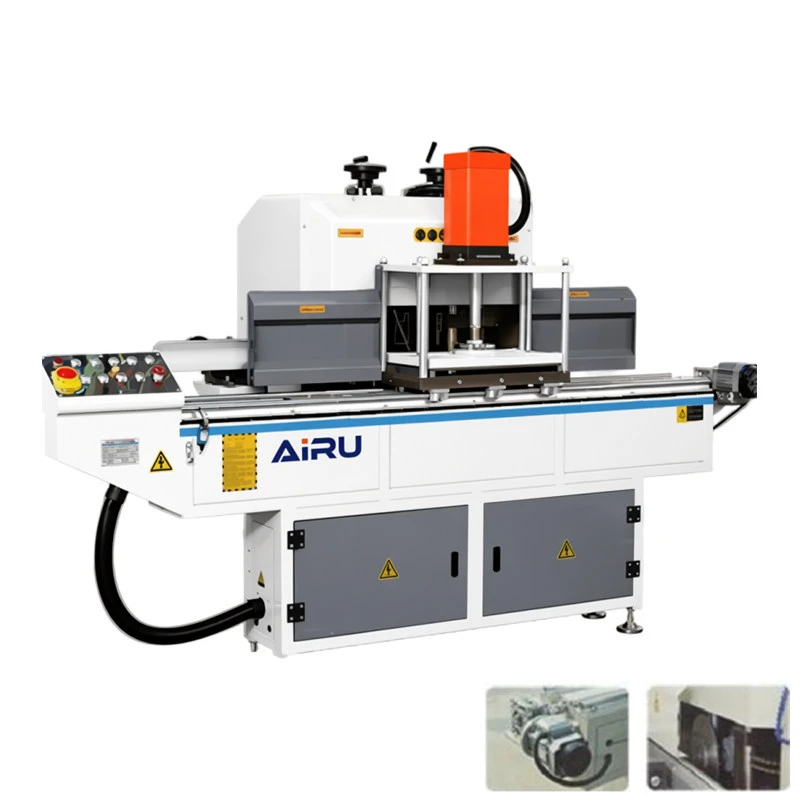
Another key interlock is the emergency stop (E-stop) interlock, but not just the big red button on the control panel. The E-stop system on these machines is linked to several other safety circuits, so if you press the E-stop, it cuts power not just to the cutter, but to the workholding clamps, the feed motor, and the hydraulic system. Wait, you might think “if I hit E-stop, I want the clamps to stay on,” but actually, in the event of an emergency (like an operator’s hand in the cutting zone), the clamps need to release slowly to avoid causing more harm, while the cutter stops instantly. Our machine’s E-stop interlock is designed to prioritize: first, stop the cutter in less than 0.2 seconds, then release the clamps safely, so if there’s a person in the danger zone, the workpiece doesn’t shift and trap them. Some machines only shut off the cutter, which can lead to the workpiece spinning and causing more damage. This E-stop interlock is also tested daily by most operators, which I recommend—testing it once a week won’t help if it fails when you need it most.
Then there’s the door access interlock, which applies if your single head copy milling machine is enclosed in a safety cage (a common setup for larger fabrication lines). If someone opens the access door to the cage while the machine is running, the interlock triggers an immediate shutdown. This is especially important for shops where multiple operators work around the machine, or where new hires might not realize the cutter is still spinning. I’ve heard stories of a worker stepping into the cage to grab a tool, not noticing the machine was running, and the door interlock stopped the cutter before it was too late. On smaller single head copy milling machines that don’t have a full cage, this interlock might be replaced with a light curtain—a set of infrared beams around the cutting zone. If an operator’s hand breaks the beam, the machine pauses the cutter instantly. Light curtains are a popular alternative for smaller shops because they’re less intrusive than a cage, but they’re just as effective, as long as they’re calibrated correctly. I always advise customers to have their light curtains checked by a technician at least once a quarter, because dust or aluminum shavings can block the beams and make the interlock stop working.
Another often-overlooked interlock is the spindle overheat interlock. The milling cutter’s spindle can get very hot during long runs—especially when machining thick aluminum extrusions, which produce a lot of friction. If the spindle overheats, the cutter can become unbalanced, leading to a broken tool or a sudden shift in the cut, which can damage the workpiece or cause injury. The overheat interlock monitors the spindle’s temperature in real time (using a thermocouple inside the spindle), and if it goes over a pre-set limit (usually around 180 degrees Fahrenheit for aluminum machining), the machine shuts down automatically and alerts the operator. This isn’t just a safety feature—it’s a way to extend the life of the machine too. I’ve had customers who skipped this interlock and ended up ruining a $500 cutter and a good piece of aluminum because the spindle overheated mid-cut. It’s a small part of the machine, but it’s saved our clients thousands in repairs and material loss.
Wait, let’s also talk about the feed speed interlock, which is tied to the workpiece size and material thickness. If you’re milling a thin aluminum extrusion, the feed speed (how fast the machine moves the workpiece into the cutter) needs to be slower than if you’re milling a thick, heavy extrusion. The feed speed interlock uses a load sensor on the spindle: if the load on the cutter is too high (which would happen if the feed speed is too fast for the material), the machine slows down the feed or stops it entirely. This prevents the cutter from breaking, which could send metal shards flying, and also prevents the workpiece from shifting because the cutter is taking too much material at once. For shops that machine a lot of different extrusion sizes, this interlock is a lifesaver—you don’t have to manually adjust the feed speed every time you switch materials, and it keeps the operation safe no matter what you’re working on.
Now, as a supplier of these machines, I want to be clear: interlocks aren’t just “add-ons” to a single head copy milling machine—they’re core components that meet OSHA (Occupational Safety and Health Administration) standards in the U.S., and similar regulatory bodies around the world. I’ve seen cheap, off-brand milling machines that skip some of these interlocks to cut costs, but that’s a false economy. The cost of an accident, a fine for non-compliance, or a machine breakdown far outweighs the small extra investment in safety interlocks. That’s why all the machines I supply—from the single head copy milling machine to the Heavy Duty Aluminum End-Milling Machine—are built with these interlocks as standard features, not optional extras. For customers who need more precision for small, intricate jobs, the 3+1 CNC End Milling Machine for Aluminum Profile also includes a redundant interlock system that adds an extra layer of protection for delicate workpieces.
I’ve worked with hundreds of fabrication shop owners over the years, and the ones who prioritize safety interlocks have lower injury rates, less downtime, and higher productivity. Operators who trust that their machine is watching out for them are more focused on their work, not on worrying about accidents. That’s the big picture here: safety interlocks aren’t just about avoiding harm—they’re about creating a more efficient, reliable operation.
If you’re in the market for a single head copy milling machine, or you want to upgrade your existing equipment with better safety features, don’t settle for a machine that cuts corners on interlocks. Reach out to our team to discuss your specific fabrication needs, whether you’re machining residential window frames, commercial curtain walls, or custom aluminum products. We can help you choose the right machine with the interlock system that fits your shop’s size, workload, and safety requirements.
References:
- Occupational Safety and Health Administration (OSHA). "Machine Guarding Requirements for Woodworking and Metalworking Machines." U.S. Department of Labor, 2024.
- Aluminum Extruders Council (AEC). "Safety Guidelines for Aluminum Fabrication Machinery." AEC Technical Report No. 12, 2023.
- Machinery’s Handbook. "Milling Machine Safety and Interlock Systems." Industrial Press, 31st Edition, 2022.
- National Institute for Occupational Safety and Health (NIOSH). "Preventing Workplace Injuries from Metalworking Machine Accidents." NIOSH Publication No. 2021-105, 2021.