

In the field of construction, aluminum formwork has become increasingly popular due to its lightweight, high strength, and reusability. The production of aluminum formwork often involves welding processes, and the use of Aluminum Formwork Welding Robot Workstations has revolutionized this aspect of manufacturing. As a supplier of Aluminum Formwork Welding Robot Workstations, I am frequently asked about the positioning accuracy of these workstations. This blog post aims to delve into the concept of positioning accuracy, its importance in aluminum formwork welding, and the factors that affect it.
Understanding Positioning Accuracy
Positioning accuracy refers to the ability of a robot workstation to precisely position the welding torch or the workpiece at the desired location. In the context of an Aluminum Formwork Welding Robot Workstation, this means accurately placing the weld joint to ensure a high - quality and consistent weld. The accuracy is typically measured in millimeters or fractions of a millimeter, and a higher degree of accuracy results in better - fitting aluminum formwork components and a more reliable final product.
For instance, in a large - scale construction project, even a small deviation in the weld position can lead to misaligned formwork, which may cause issues during the concrete pouring phase. This can result in uneven surfaces, structural weaknesses, and additional time and cost for rework. Therefore, the positioning accuracy of the welding robot workstation is crucial for maintaining the quality and integrity of the aluminum formwork.

Importance of Positioning Accuracy in Aluminum Formwork Welding
- Quality of Welds: High - precision positioning ensures that the weld is placed exactly where it is needed. This leads to a stronger and more consistent weld, which is essential for the structural integrity of the aluminum formwork. A well - positioned weld can withstand the stress and load placed on the formwork during the construction process, reducing the risk of failure.
- Product Consistency: In mass production of aluminum formwork, consistency is key. A welding robot workstation with high positioning accuracy can produce identical welds on each formwork component, ensuring that all parts fit together perfectly. This consistency not only improves the overall quality of the product but also speeds up the assembly process on the construction site.
- Cost - Efficiency: By minimizing the need for rework due to inaccurate welds, a high - accuracy welding robot workstation can save both time and money. Reworking misaligned welds requires additional labor, materials, and time, all of which add to the production cost. With precise positioning, these costs can be significantly reduced.
Factors Affecting Positioning Accuracy
- Robot Kinematics: The design and structure of the robot arm play a significant role in positioning accuracy. A well - designed robot with high - quality joints and linkages can move more precisely. For example, robots with advanced kinematic models can compensate for small errors in movement, resulting in better positioning.
- Control System: The control system of the welding robot workstation is responsible for sending commands to the robot to move to the desired position. A sophisticated control system can accurately calculate the path and speed of the robot, ensuring that it reaches the target location with minimal error.
- Workpiece Fixturing: Proper fixturing of the aluminum formwork workpiece is essential for accurate positioning. If the workpiece is not held securely in place, it can move during the welding process, leading to inaccurate welds. High - quality fixtures that can hold the workpiece firmly and precisely are necessary for achieving optimal positioning accuracy.
- Environmental Factors: Temperature, humidity, and vibration can all affect the positioning accuracy of the welding robot workstation. For example, changes in temperature can cause the robot components and the workpiece to expand or contract, leading to small changes in position. Therefore, the workstation should be installed in a stable environment with controlled temperature and humidity, and vibration - isolation measures should be taken.
Measuring Positioning Accuracy
There are several methods to measure the positioning accuracy of an Aluminum Formwork Welding Robot Workstation. One common method is to use a laser tracker or a coordinate measuring machine (CMM). These devices can accurately measure the position of the robot's end - effector or the workpiece and compare it to the desired position. The difference between the actual and desired positions is the positioning error.
Another approach is to perform test welds on sample workpieces and then inspect the welds using non - destructive testing methods such as ultrasonic testing or X - ray inspection. These methods can detect any defects in the welds caused by inaccurate positioning, allowing the operator to adjust the workstation settings accordingly.
Our Aluminum Formwork Welding Robot Workstation
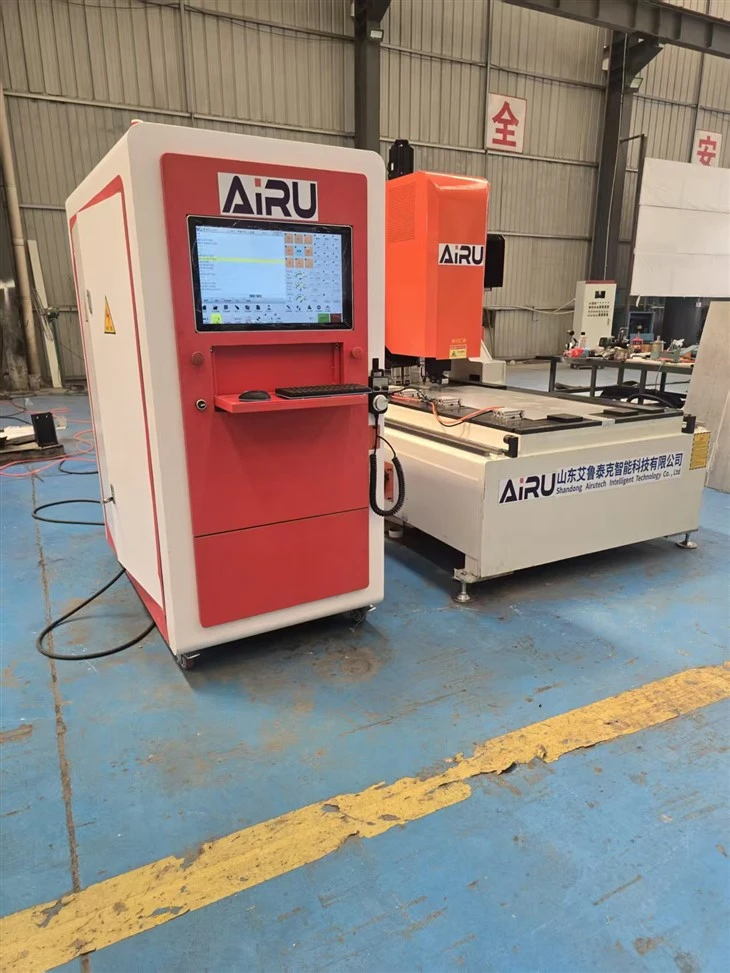
As a supplier of Aluminum Formwork Welding Robot Workstation, we are committed to providing high - quality products with excellent positioning accuracy. Our workstations are equipped with advanced robot arms and control systems that are designed to achieve precise positioning.
We also pay great attention to the design of the workpiece fixturing system. Our fixtures are made of high - strength materials and are carefully engineered to hold the aluminum formwork securely and accurately. In addition, we offer environmental control solutions to minimize the impact of external factors on the positioning accuracy.
Our Aluminum Formwork Friction Stir Welding Machine and Aluminum Formwork Welding Machine are also designed to work in harmony with the welding robot workstation, ensuring a seamless and efficient welding process.
Contact for Purchase and Negotiation
If you are interested in our Aluminum Formwork Welding Robot Workstation or have any questions about its positioning accuracy or other features, please feel free to contact us. We are more than happy to provide you with detailed information, technical support, and a quote. Our team of experts is dedicated to helping you find the best solution for your aluminum formwork welding needs.
References
- Groover, M. P. (2016). Automation, Production Systems, and Computer - Integrated Manufacturing. Pearson.
- Schmid, S., & Arentoft, M. (Eds.). (2015). Welding Handbook: Volume 2: Welding Processes. American Welding Society.
- Degarmo, E. P., Black, J. T., & Kohser, R. A. (2003). Materials and Processes in Manufacturing. Wiley.