

As a supplier of Building Formwork Milling Machines, ensuring the synchronization of multiple axes in these machines is crucial for achieving high - precision and efficient production. In this blog, I'll share some effective methods and considerations on how to ensure the synchronization of multiple axes in a building formwork milling machine.
Understanding the Importance of Axis Synchronization
In a building formwork milling machine, multiple axes are often involved in the machining process. These axes work together to perform tasks such as cutting, grooving, and shaping the formwork materials. If the axes are not synchronized properly, it can lead to a series of problems. For example, uneven cuts may occur, which will affect the quality of the formwork products. In addition, inaccurate synchronization can also cause mechanical stress on the machine components, reducing the service life of the equipment and increasing maintenance costs. Therefore, ensuring the synchronization of multiple axes is essential for both product quality and machine durability.
Key Factors Affecting Axis Synchronization
Mechanical Structure
The mechanical structure of the building formwork milling machine plays a fundamental role in axis synchronization. The design and manufacturing accuracy of the guide rails, ball screws, and couplings can significantly impact the movement accuracy of each axis. For instance, if the guide rails are not installed parallelly or have uneven surfaces, the axes may deviate during movement, resulting in synchronization errors. High - quality mechanical components with precise manufacturing and proper installation are the basis for good axis synchronization.
Control System
The control system is the brain of the building formwork milling machine. It is responsible for sending commands to each axis motor and coordinating their movements. A well - designed control system can accurately calculate the position, speed, and acceleration of each axis according to the machining requirements. Advanced control algorithms, such as PID (Proportional - Integral - Derivative) control, can continuously adjust the motor output to minimize synchronization errors. Moreover, the communication between the control system and the motor drivers should be stable and reliable to ensure timely and accurate command transmission.
Motor Performance
The performance of the motors used in the building formwork milling machine also affects axis synchronization. Motors with high torque, good speed stability, and fast response are preferred. Different types of motors, such as servo motors and stepper motors, have their own characteristics. Servo motors are generally more suitable for high - precision applications because they can provide precise position control and can quickly adjust to changes in load. On the other hand, stepper motors are more cost - effective but may have limitations in terms of accuracy and speed regulation.
Methods to Ensure Axis Synchronization
Hardware - based Synchronization
High - Precision Mechanical Components
Using high - precision guide rails, ball screws, and couplings can reduce mechanical errors and improve the synchronization of multiple axes. For example, linear guide rails with high - precision rolling elements can provide smooth and stable movement for the axes. Ball screws with high lead accuracy can ensure accurate linear displacement. Couplings with good flexibility and torsional stiffness can effectively transmit torque between the motor and the transmission mechanism while compensating for small misalignments.
Synchronous Belts and Gear Drives
In some building formwork milling machines, synchronous belts or gear drives can be used to connect multiple axes. Synchronous belts have the advantages of high transmission efficiency, low noise, and accurate transmission ratio. They can ensure that the movement of different axes is synchronized to a certain extent. Gear drives, on the other hand, can provide high - torque transmission and precise angular positioning. However, proper lubrication and maintenance are required to ensure their long - term reliable operation.
Software - based Synchronization
Master - Slave Control Strategy
The master - slave control strategy is a commonly used method in axis synchronization. In this strategy, one axis is designated as the master axis, and the other axes are set as slave axes. The master axis determines the reference position and speed, and the slave axes adjust their movements according to the master axis. For example, in a three - axis building formwork milling machine, the X - axis can be set as the master axis, and the Y - axis and Z - axis can be set as slave axes. The control system continuously monitors the position and speed of the master axis and sends corresponding adjustment commands to the slave axes to keep them synchronized.
Electronic Gearing
Electronic gearing is another advanced software - based synchronization method. It uses the control system to simulate the mechanical gearing relationship between multiple axes. By setting the appropriate gear ratio, the control system can ensure that the movements of different axes are proportional to each other. For example, if the gear ratio between the X - axis and the Y - axis is set to 1:2, when the X - axis moves a certain distance, the Y - axis will move twice that distance in a synchronized manner.
Regular Maintenance and Calibration
Regular maintenance and calibration are essential for maintaining the synchronization of multiple axes in a building formwork milling machine.
Maintenance
Regularly inspecting and lubricating the mechanical components can prevent wear and tear and ensure their normal operation. For example, checking the lubrication level of the guide rails and ball screws and adding lubricant in time can reduce friction and improve the movement smoothness of the axes. Cleaning the motor cooling fans and checking the electrical connections can also prevent overheating and electrical failures.
Calibration
Periodic calibration of the control system and the axes is necessary to correct any accumulated errors. This includes calibrating the position sensors, speed sensors, and motor parameters. By comparing the actual movement of the axes with the expected values, the control system can be adjusted to ensure accurate synchronization. For example, using a laser interferometer to measure the linear displacement accuracy of the axes and then adjusting the control parameters accordingly.
Our Building Formwork Milling Machine Products
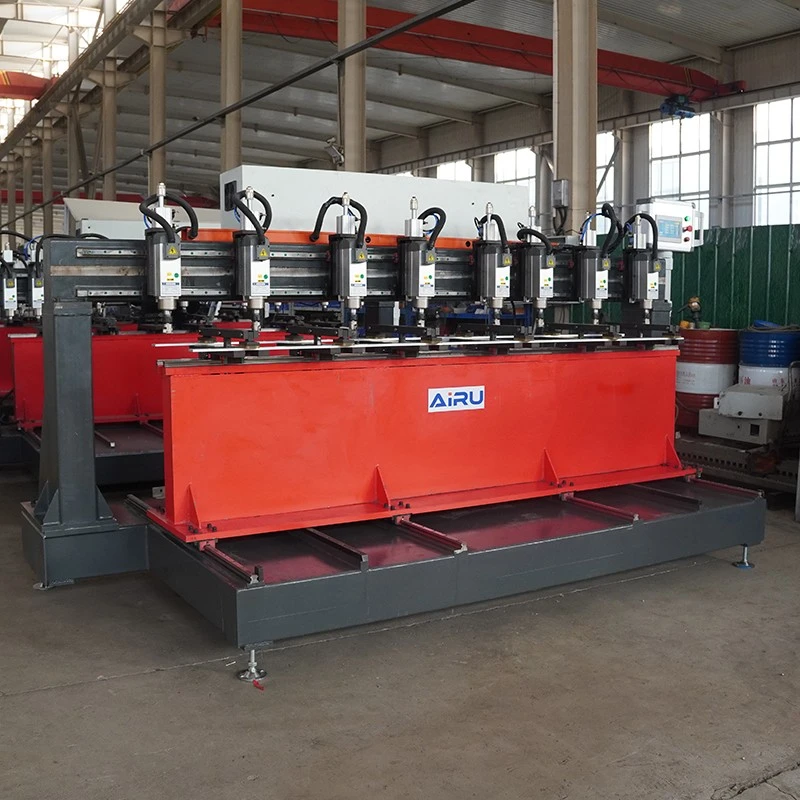
As a professional supplier of building formwork milling machines, we offer a wide range of high - quality products. Our Single - head Aluminum Formwork Slotting Machine is designed for precise slotting of aluminum formworks. It features advanced control technology to ensure the synchronization of multiple axes during the slotting process, resulting in high - quality slotting results.
Our Steel Formwork Milling Machine is suitable for machining steel formworks. With a robust mechanical structure and a reliable control system, it can achieve accurate and synchronized movement of multiple axes, meeting the high - precision requirements of steel formwork machining.
In addition, our Fully Automatic Formwork Slotting Machine is an advanced solution for large - scale formwork production. It integrates the latest axis synchronization technology and automation features, allowing for efficient and accurate slotting operations.
Conclusion
Ensuring the synchronization of multiple axes in a building formwork milling machine is a complex but crucial task. By considering the key factors such as mechanical structure, control system, and motor performance, and adopting appropriate hardware - based and software - based synchronization methods, as well as regular maintenance and calibration, we can achieve high - precision and efficient axis synchronization. As a supplier, we are committed to providing our customers with high - quality building formwork milling machines that meet their production needs. If you are interested in our products or have any questions about axis synchronization in building formwork milling machines, please feel free to contact us for procurement negotiation.
References
- Smith, J. (2018). Precision Machining Technology. New York: Wiley.
- Johnson, R. (2019). Control Systems for Machine Tools. London: Elsevier.
- Brown, A. (2020). Motor Drives and Applications. Sydney: McGraw - Hill.