

With high precision and flexibility, laser tube cutting machines are compatible with various tube shapes, covering the main needs of industrial manufacturing:
**Round tubes** are the most basic type for cutting. They can handle small precision copper tubes and stainless steel tubes (as thin as a few millimeters) to thick-walled steel tubes (up to tens of centimeters in diameter). Widely used in mechanical parts, furniture brackets, fluid transportation, etc., the cut tube ends are smooth and burr-free, requiring no secondary grinding-far more efficient than traditional methods.
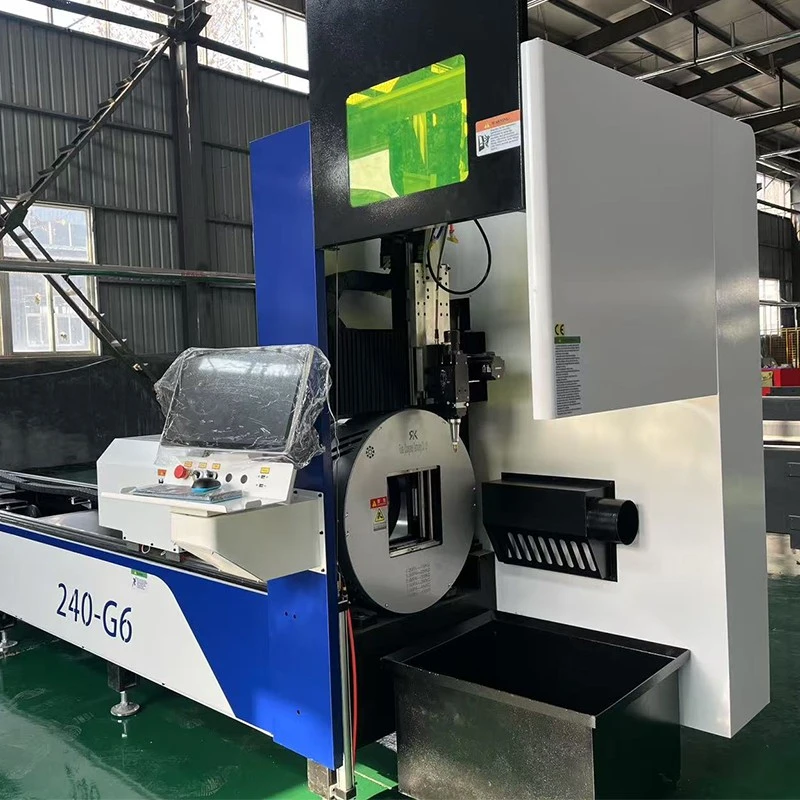
**Square and rectangular tubes** (collectively called square-rectangular tubes) are structurally stable, making them ideal for steel structures, door and window frames, display stands, etc. Laser tube cutting machines not only cut tube ends and sides accurately but also process special-shaped holes (e.g., square holes) and achieve multi-angle bevel cuts. They ensure the perpendicularity between the cut and the tube's edges, meeting complex assembly requirements.
**Special-shaped tubes** highlight the core advantage of laser cutting machines. This category includes oval tubes, triangular tubes, hexagonal tubes, flat tubes, and tubes with special cross-sections (e.g., C-shaped steel for solar brackets, special-shaped aluminum tubes for auto parts). Equipped with dedicated fixtures for fixing and CNC positioning, the machines cut stably along the contour of special-shaped tubes-solving issues like offset and deformation common in traditional processes. They are well-suited for high-precision industries such as new energy and medical equipment.
In addition, some high-end models support cutting **multi-prismatic tubes** (e.g., octagonal tubes for decorative building materials) and **corrugated tubes** (for pipeline compensation). They can preserve the corrugated structure of corrugated tubes without damaging their elasticity. Overall, no frequent mold replacement is needed; switching between tube types only requires adjusting parameters via software, enabling flexible adaptation to diverse processing needs.